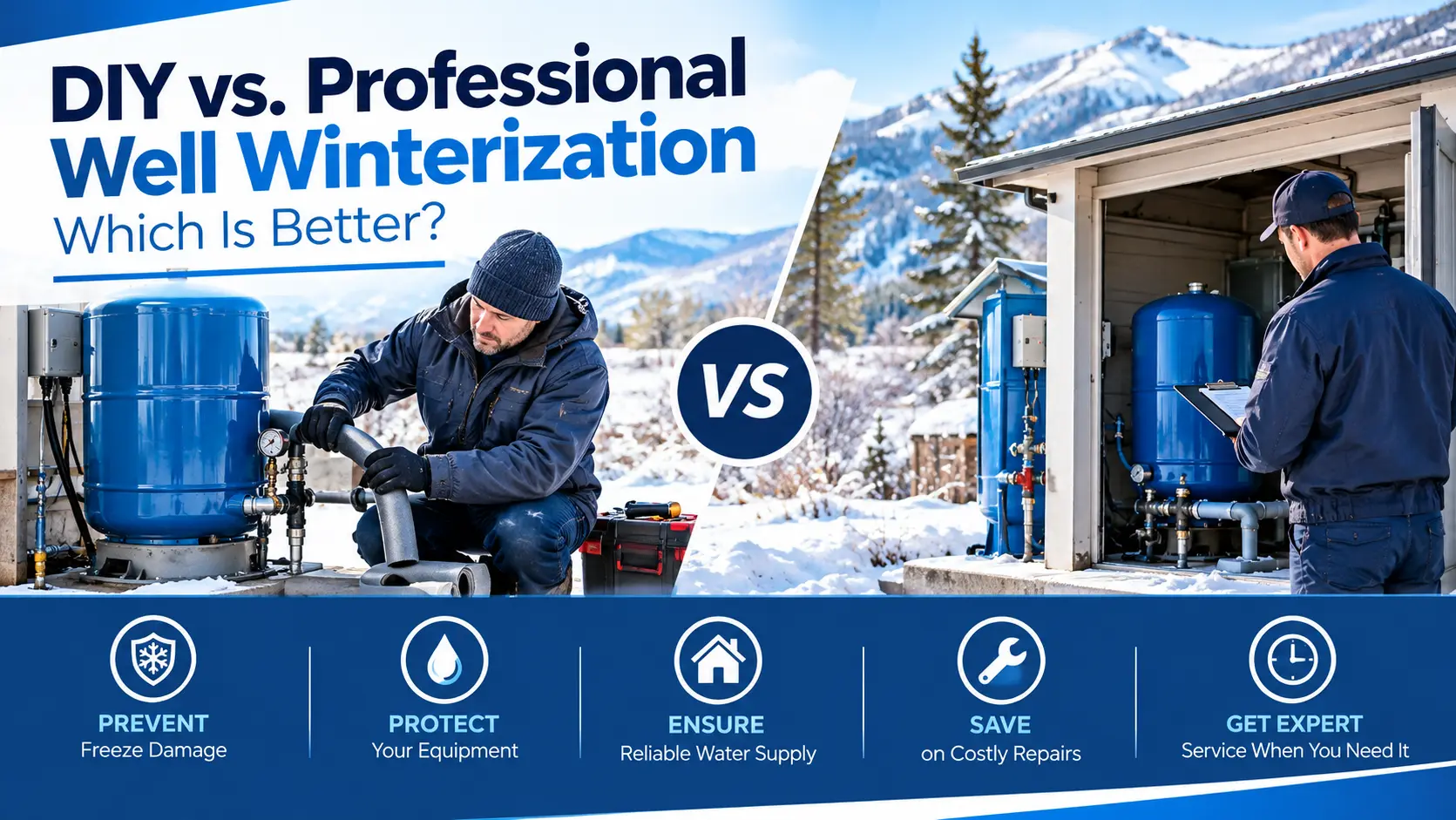
DIY vs. Professional Well Winterization
If your home uses a private well, winterizing it before the harsh winters arrive should be a top priority this month.
Most homeowners assume winterizing the well system is pretty simple, but it has more to it than wrapping a few pipes. Depending on your setup, you might need to protect the pump, pressure tank, valves, and other equipment.
Now, a common question arises: can you handle winterizing your well system yourself, or should you call a professional? This blog will answer exactly that, so keep reading to learn more.
| Prepare your well for winter. Contact Us! |
Why Is Winterizing Your Well System So Important?
Water expands by about 9% when it freezes. Inside a pipe or fitting, that expansion can create enough pressure to crack the material. You may not notice the damage until the ice thaws and water begins leaking.
Depending on where freezing occurs, you could face several problems:
- A frozen supply line can cut off water to your faucets, toilets, and showers.
- Small tubes connected to the pressure switch can freeze or crack, interfering with how the pump starts and stops.
- Exposed plumbing and water-filled, above-ground pumps can split and leak after thawing.
- If freezing blocks water flow and the pump keeps running, it may overheat and get severely damaged.
That’s why preparing your well system before freezing weather arrives helps protect both your equipment and your household’s water supply. Here’s how to decide which tasks belong on your DIY list and when to bring in a well contractor for winterization.
DIY or Professional Well Winterization: Which One Should You Choose?
You might be a DIY expert and have completed several tasks on your own with the help of YouTube videos.
But your well system’s maintenance and especially its winterization depend more on your system’s layout, the equipment involved, and whether you understand the shutdown procedure.
The table below will help you choose between DIY and professional well winterization:
| Winterization Task | DIY Feasible | Professional Recommended |
| Inspect exposed pipes | Yes, where safely accessible | If you find damage or leaks |
| Add pipe insulation | Usually, on accessible plumbing | For hard-to-reach areas or uncertain freeze protection |
| Check pump-house doors and gaps | Yes | If the enclosure needs major improvements |
| Shut off pump power | If you know the correct breaker or control | If the controls are unfamiliar |
| Drain simple exposed plumbing | If you know the drain points and procedure | If water could remain trapped |
| Drain the pressure tank and system | Only if you understand the setup | If you cannot confirm proper drainage |
| Drain filters or treatment equipment | Only as directed by the manufacturer | For complex or unfamiliar equipment |
| Work on electrical controls | No | Yes |
| Repair freeze-damaged components | No | Yes |
| Pull or replace a well pump | No | Yes |
Note: Before you start any DIY work, read the instructions for your equipment rather than following a general checklist as a complete shutdown plan.
When Should You Call a Well Professional To Handle the Winterization?
You must arrange a well service visit if:
- You don’t know where the drain points are.
- You can’t tell whether the pressure tank has drained correctly.
- Your pump or pressure equipment is above ground in an unheated location.
- The property will remain vacant for much of the winter.
- You have filters, softeners, UV equipment, storage tanks, or a more complicated plumbing layout.
- You suspect something has already frozen.
- You see a cracked fitting, leaking tank, damaged pipe, or electrical problem.
- Your pump runs, but the home has little or no water.
- The system needs to be opened, disconnected, repaired, or modified.
| Winterize your well with expert help. Call 775-851-1600! |
Does Professional Winterization Cost More Than DIY?
Yes. Professional assistance includes a service visit and labor charges, while basic DIY preparation may only require some tools. But you should not just focus on the upfront price because DIY has its own risks that may cost you more later.
For example, a missed drain point can lead to a cracked fitting, a leak, or a home without water. More serious damage could mean water pump repair or water pump replacement, rather than routine winter preparation.
When you call a professional, they conduct a detailed inspection. During the inspection, the well expert may also uncover a pressure tank problem, a leaking connection, or a pump that starts and stops too often. Finding those issues before winter gives you time to arrange repairs instead of responding to a sudden breakdown on a random winter afternoon.
Frequently Asked Questions About Winterizing a Well Pump
1. Do I need to winterize a submersible well pump?
Usually, the submerged pump itself is protected because it sits below the frost line, the depth to which the ground freezes. However, exposed pipes, fittings, controls, and a pressure tank in an unheated space may still need protection. A well professional can identify those vulnerable areas and explain what needs insulation, heat, or draining without unnecessarily removing the pump from the well.
2. Can I leave the heat on instead of winterizing my well system in Reno?
Keeping the heat on can protect indoor plumbing, but it will not automatically protect a separate pump house or exposed outdoor lines. A power outage or heating failure can also leave equipment vulnerable while you are away. Before an extended absence, have a professional assess whether heat and insulation are enough or whether exposed sections should be drained.
3. How do I know if my well system is ready for a freeze?
You should know where your exposed pipes, drain points, pressure equipment, and other vulnerable components are before freezing weather arrives. Check that exposed plumbing is protected, pump-house doors and gaps are sealed, and any heating equipment is working properly. If you are unsure whether the system has been properly prepared, have a well professional inspect it before temperatures drop.
Read More!
- Emergency Water Well Repairs: What to Do During Winter
- Preparing Your Water Well for Winter: Essential Tips for Cold Weather Maintenance in Northern Nevada
- Winter Power Outages in Northern Nevada: How They Impact Your Well & Water Pump
- Frozen Well Pipes & No Water in Winter: What Reno Homeowners Need to Know
Takeaway
You can handle well pump winterizing yourself when the freeze-protection tasks are simple and easy to access. But if you need to shut down the system for winter, are unsure about the equipment, or see signs of damage, it is safer to call a professional.
The comparison table above can help you decide the right step. So handle the tasks you understand, get help with the ones you’re not sure about, and address existing pump problems before freezing weather arrives.
Get Your Well Ready for a Reno Winter With Bruce MacKay Pump & Well Service Inc.
Looking for a reliable well service provider in Reno? You’re just a call away!
Bruce MacKay Pump & Well Service Inc. has served Northern Nevada and Eastern California since 1981. Our licensed (NV Lic #23095 & #23096 | CA Lic #595616) and insured team is expert in handling all sorts of well and pump work, with 24/7 emergency service availability.
We’re also a BBB-accredited team with an A+ rating. Whether you need guidance on winterizing your well system, water pump repair in Reno, or water pump replacement, we’ll first inspect your equipment, explain any problems, and recommend the next suitable step.
Call 775-851-1600 to schedule your well and pump service in Reno today.