How Does a Water Softener Work? A Simple Guide for Homeowners
Have you noticed white spots on your faucets, soap that never seems to rinse completely, or a crusty layer building up around your showerhead? If you get your water from a private well, you may also notice changes in taste, staining, or water pressure.
Hard water could be the root cause of these issues. It contains higher amounts of dissolved minerals, mainly calcium and magnesium. These minerals are not normally a health concern, but they can create problems throughout a home. Over time, they can leave scale on fixtures, build up inside plumbing and water heaters, and make soaps and detergents less effective.
Installing a household water softener system is the most effective way to eliminate these frustrating issues. So let’s break down how a water softener works, what it can and cannot remove, and when professional testing makes sense.
| Have hard water concerns? Contact Us Today! |
What Is Hard Water, and Why Can It Become a Problem?
Water naturally picks up minerals as it moves through soil and rock. Groundwater and well water can contain calcium and magnesium because these minerals dissolve in groundwater underground.
Having these minerals in your water does not automatically mean the water is unsafe. The problem is what they can do inside your home.
Common signs of hard water:
- White or chalky deposits around faucets
- Spots or cloudy film on glasses and dishes
- Scale inside kettles and coffee makers
- Soap scum around showers and tubs
- Needing more soap or detergent to clean effectively
- Mineral buildup on showerheads
- Scale inside water heaters and plumbing fixtures
The U.S. Geological Survey uses the following general hardness ranges:
| Hardness Level | Calcium Carbonate(mg/L) | What It Means |
| Soft | 0-60 mg/L | Little hardness |
| Moderately hard | 61-120 mg/L | Some mineral buildup may occur |
| Hard | 121-180 mg/L | Scale becomes more noticeable |
| Very hard | More than 180 mg/L | Greater potential for scale problems |
The actual hardness at your home is more useful than a citywide average, especially if your property uses a private well.
How Does a Water Softener Work Step by Step?
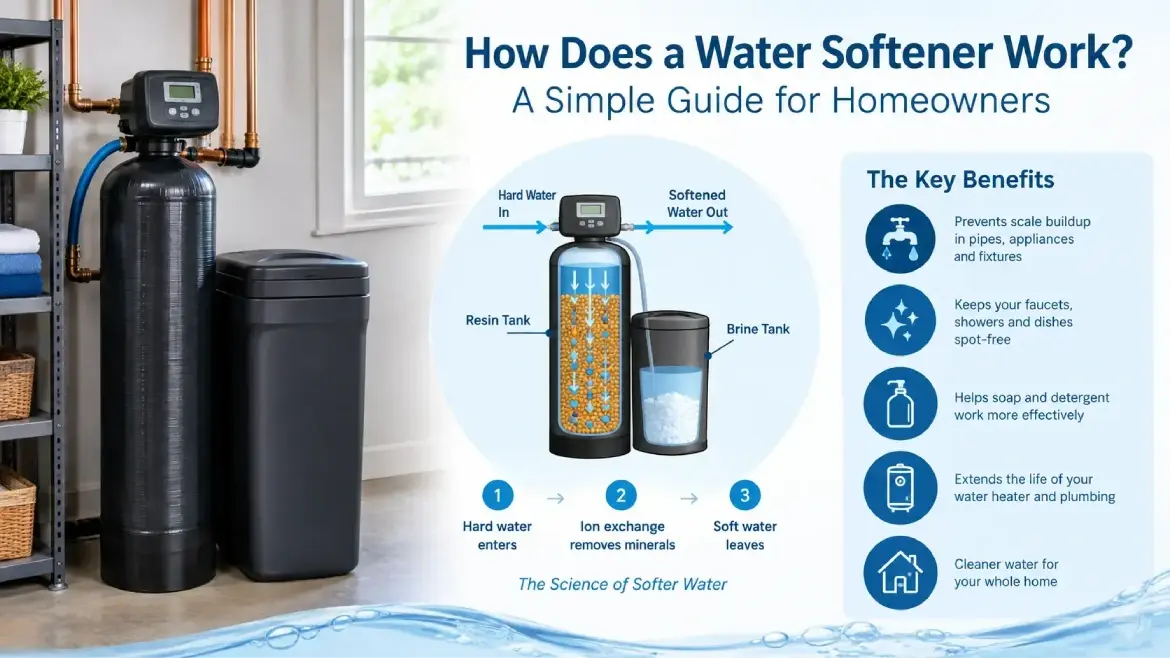
A water softener works through a scientific process called ion exchange. It swaps hard minerals for soft ones so scale never forms in your home.
A standard setup features three primary components: a resin tank, a brine tank, and a control valve. Here is how it works:
- Hard Water Enters the Resin Tank: Untreated water flows into the top of the resin tank and passes down through thousands of tiny, negatively charged resin beads.
- Ion Exchange Occurs: The resin beads are coated with positively charged sodium (or potassium) ions. Because calcium and magnesium hold a stronger positive charge, they stick to the resin beads. In exchange, the resin releases a small amount of harmless sodium into the water.
- Softened Water Enters Your Home: The newly softened water leaves the tank, free of heavy minerals, and flows out to your faucets, showerheads, and appliances.
What Happens During the Water Softener Regeneration Cycle?
Over time, the resin beads inside a water softener fill up with calcium and magnesium. Once they reach their working capacity, they need to be cleaned before they can keep softening your water.
That cleaning process is called regeneration.
Most automatic systems are set to regenerate when water use is low, often overnight. The exact timing depends on the softener’s settings and how much water your household uses.
So, what actually happens while the system is regenerating?
1. Backwash
Water flows through the resin tank in the opposite direction. This loosens the resin bed and washes out all the dirt, sediment, and other particles that may have collected there. The used water then leaves through the drain.
2. Brine Draw
Next, the salty water stored in the brine tank is pulled into the resin tank. The brine helps remove the calcium and magnesium that the resin beads collected during normal operation.
Those minerals are carried away with the wastewater instead of staying trapped in the resin.
3. Fast Rinse
Once the brine has done its job, fresh water moves through the tank. This washes away the remaining salt and loosened minerals, leaving the resin ready to work again.
4. Brine Refill
Fresh water fills the brine tank once more, dissolving the salt bags you added so it is ready for the next cleaning cycle.
Why Is Water Well Testing Important Before Installing a Softener?
If your home uses a private well, water well testing should usually come before selecting water-treatment equipment because hardness may be only one part of the picture.
A well can also have iron, manganese, sediment, or other water-quality concerns. Certain conditions can even interfere with the operation of a softener or foul the resin if the system is not designed correctly.
Testing gives you a clearer picture of what you are dealing with. It can show how hard the water is, whether iron or manganese is present, and whether the water needs another type of treatment before it reaches the softener. It can also help determine what type and size of system is appropriate for your home.
For well owners, it can also be useful to look at the water system as a whole. If you have changing pressure, reduced flow, unusual pump behavior, or other supply problems, those may not be caused by hard water at all. A water well pump service professional can inspect the pumping system separately from the water-treatment equipment.
That distinction can save homeowners from trying to solve the wrong problem.
| Get Reliable Water Well Testing in Reno – Call (775) 851-1600 |
How to Maintain Your Water Softener for Long-Lasting Performance
A quality softener lasts anywhere from 10 to 15 years, but it requires basic maintenance to keep operating at peak performance. Skipping routine care leads to salt bridges, iron-fouled resin, and sudden water pressure drops.
Follow these practical maintenance steps to keep your equipment running smoothly:
- Check Salt Levels Monthly: Keep your brine tank at least half-full of salt, and make sure salt levels sit a few inches above the water line.
- Break Up Salt Bridges: High humidity can cause salt to form a hard crust inside the brine tank, leaving a space beneath it. Gently break up any crust using a broom handle.
- Clean the Resin Bed: If your water contains iron, use a specialized resin cleaner once or twice a year to wash away heavy iron buildup.
- Inspect the Brine Tank Bottom: Clean out thick salt sludge from the bottom of your brine tank every few years to prevent clogging.
When dealing with complex well systems, your softener works side-by-side with your pump setup. Scheduling routine water well pump service keeps your system’s pressure balanced, protecting your softener’s sensitive control valves from unexpected pressure surges.
Frequently Asked Questions About Water Softeners
1. Is a water softener really worth having?
It depends on your water. If hardness is causing frequent scale, spotted dishes, soap buildup, or problems with water-using equipment, installing a water softener can make a noticeable difference. However, mild hardness may not justify treatment for every homeowner. Testing the water first is the best way to make that decision instead of buying a system based only on symptoms. An experienced water-treatment professional can help interpret the results and properly size the equipment.
2. Can you drink water from a water softener?
Many people do drink softened water, but sodium-based softeners add sodium as calcium and magnesium are removed. The amount depends partly on how hard the incoming water is. People who need to limit sodium may want to discuss softened drinking water with a healthcare professional or consider leaving a separate unsoftened drinking-water tap. A water-treatment professional can also explain available system configurations.
3. Do Reno and Northern Nevada homes need water softeners?
There is no single answer for every property. Water hardness can vary depending on location, and private wells can have their own mineral levels. If you are seeing white scale, spotting, or mineral buildup, have the water tested rather than assuming your neighbor’s results apply to your home. A local well and water-treatment professional can recommend a system based on your actual water chemistry.
Read More!
- Salt Pellets vs. Crystals vs. Block Salt: Which Is Right for Your Water Softener?
- What’s the difference between a water filter and a water softener?
- What to Do If Your Well Test Fails – Steps & Solutions
- Restore Your Well Pump After a Power Outage Quickly
Takeaway
A water softener uses ion exchange to capture calcium and magnesium before those hardness minerals travel throughout your home. The system periodically regenerates so the resin can continue doing its job.
But a softener is not a cure-all for every water problem.
If you see scale, staining, strange odors, changing water quality, or other issues, start by finding out what is actually in your water. The right test can tell you whether you need softening, filtration, another treatment method, or attention to the well system itself.
| Get the Right Water Softener for Your Home – Call (775) 851-1600 |
Get the Right Water Solution with Bruce MacKay Pump & Well Service Inc.
If you’re also dealing with hard water in your home or are not sure about it, Bruce MacKay Pump & Well Service Inc. can help you make that decision based on your actual water and well system.
Bruce MacKay Pump & Well Service Inc. is a BBB- accredited team with an A+ rating, serving Northern Nevada and Eastern California since 1981. We provide:
- Water softener and filtration services in Reno
- Water well testing in Reno
- Water well pump service in Reno
Whether you are dealing with hard water, mineral buildup, water-quality concerns, or a well-system problem, our fully licensed and insured team can help identify the cause and recommend the right next step (NV Lic #23095 & #23096 | CA Lic #595616).
Call (775) 851-1600 to have your water or well system professionally evaluated.